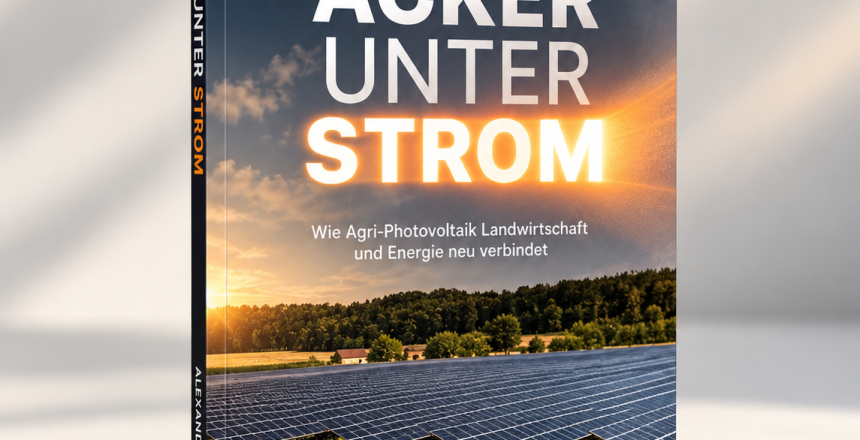
How can agricultural land be transformed into an economically viable agri-PV project—without making agriculture an afterthought?
Agri-photovoltaics brings together two worlds that have long been viewed separately: agriculture and energy production. However, between a good idea and a working project lie factors such as site suitability, system design, grid connection, permitting, economic viability, financing, and, increasingly, battery storage.
"Acker unter Strom" is a practical reference book for anyone who not only wants to understand agri-PV but also wants to realistically evaluate projects.
In it, Alexander Rhein, managing director of ReGaWatt GmbH, combines practical project experience with the technical, agricultural, and economic aspects of modern agri-PV projects.
Among other things, the book shows:
- which agri-PV systems are suitable for different types of agricultural land use,
- why agriculture should be the starting point for planning,
- what role grid connection and grid interconnection points play in economic efficiency,
- how revenue models and profitability can be categorized,
- why battery storage and colocation are increasingly becoming part of the plant design,
- how financing and creditworthiness are viewed,
- what typical mistakes jeopardize projects or make them uneconomical,
- as water, digitalization, and smart plant control become increasingly important,
- and how an agri-PV project can be systematically developed, from the initial site assessment through to implementation.
The point here is not to portray agri-PV as the better solution across the board. Not every site is suitable. Not every technically feasible project makes economic sense. And not every additional megawatt-hour automatically improves the overall system.
The focus is therefore on a different question:
How can agriculture, energy, storage, the grid, and economic efficiency be integrated in a way that creates more value from a given area over the long term?
A book for farmers, landowners, project developers, investors, banks, local governments, and decision-makers in the energy sector who want to gain a thorough and practical understanding of agri-photovoltaics.
Not more space. More value from the same amount of space.